Two Words Across Two Oceans
Emrys is the name of the place where the red dragon sleeps. In the ninth-century chronicle Historia Brittonum — compiled around 828 AD and attributed to the monk Nennius — a Welsh hillfort called Dinas Emrys stands in the mountains of Gwynedd, and beneath a hidden pool two dragons lie coiled, red and white, whose eventual awakening will determine the fate of the island of Britain. The red dragon is the Briton. The white dragon is the invader. When the boy Ambrosius reveals this to the treacherous king Vortigern, the dragons wake, fight, and the red one wins.
That dragon became Y Ddraig Goch — the heraldic beast raised on the battle standard of Cadwaladr in the seventh century, carried by Henry Tudor at Bosworth Field in 1485, and formalized as the national flag of Wales by Royal Proclamation in 1959. He has been waiting on a hilltop for twelve centuries, patient as a lighthouse.
Lēʻahi is his station. The promontory English sailors named Diamond Head rises 760 feet above the southeastern shore of Oʻahu. Its Hawaiian name carries a navigational memory: one reading holds that lei ahi — wreath of fire — recalls the beacon fires kept at the summit to mark the channel into Honolulu Harbor for approaching vessels. The U.S. Lighthouse Board formalized the headland’s duty in 1917 when it commissioned the Diamond Head Light, and the beacon has held its post, mechanized and automated, for more than a century since.
The Transpacific Yacht Race — sailed from the California coast to these waters since 1906 — ends at the buoy off Lēʻahi’s tip. Together the name means: the sleeping fire of a Welsh mountain, called to duty at the lighthouse of the Pacific. The embers of one world lit the way into another.
The Era of JADA
JADA was launched in 1938 from the Stephens Brothers yard in Stockton, California — a yard the press called the builder of the “Rolls-Royce of motor yachts,” known from 1902 until its closing in 1987 for some of the finest wooden hulls on the Pacific coast. Her lines were drawn for a racing yawl: sixty-five feet of teak and heart-timber, a tall main rig, a hull designed to chase the trade winds from San Pedro to Diamond Head.
The legend told aboard JADA holds that the beacon-keeper had been at his post far longer than any yacht race — ten thousand years of fires lit for ships that never acknowledged him, never left an offering, never once said thank you. The story notes, without apology, that the Stephens brothers who drew JADA’s lines carried Anglo-Welsh blood in their family’s keeping: the red dragon was, in some sense, their homeland guardian, sleeping in his mountain and waiting for someone to cross the right ocean.
When a racing yawl from that yard first crossed the open Pacific horizon and her crew read the race chart — finish buoy: Diamond Head — something very old recognized the name carved into her stern. And grew very still.
Honor Given to an Elder
The story JADA’s crew passes down holds that the queen did not conquer the keeper of the fire. You cannot conquer something that has been burning longer than your civilization. Conquest would have been an insult, and a dragon who has kept his post for ten thousand years is not easily insulted — he has simply seen it before.
She came to Lēʻahi at dusk, before the first race, standing at the bow as the headland rose against the setting sun. She named the dragon’s work by its proper title.
The fire, which had burned ten thousand years in a silence of perfect and unpraised duty, rose to meet her. Not as a weapon. As a friend that had been waiting, simply, for someone to ask.
She asked him to teach her everything he knew about fire afloat — how lightning found masts, how galley flames walked decks, how the warmth below the waterline was the difference between a crew and a wreck. He agreed without ceremony. The old fire is not a servant; he chose to guard. That is a different thing entirely, and it matters.
The Hearth and the Beacon
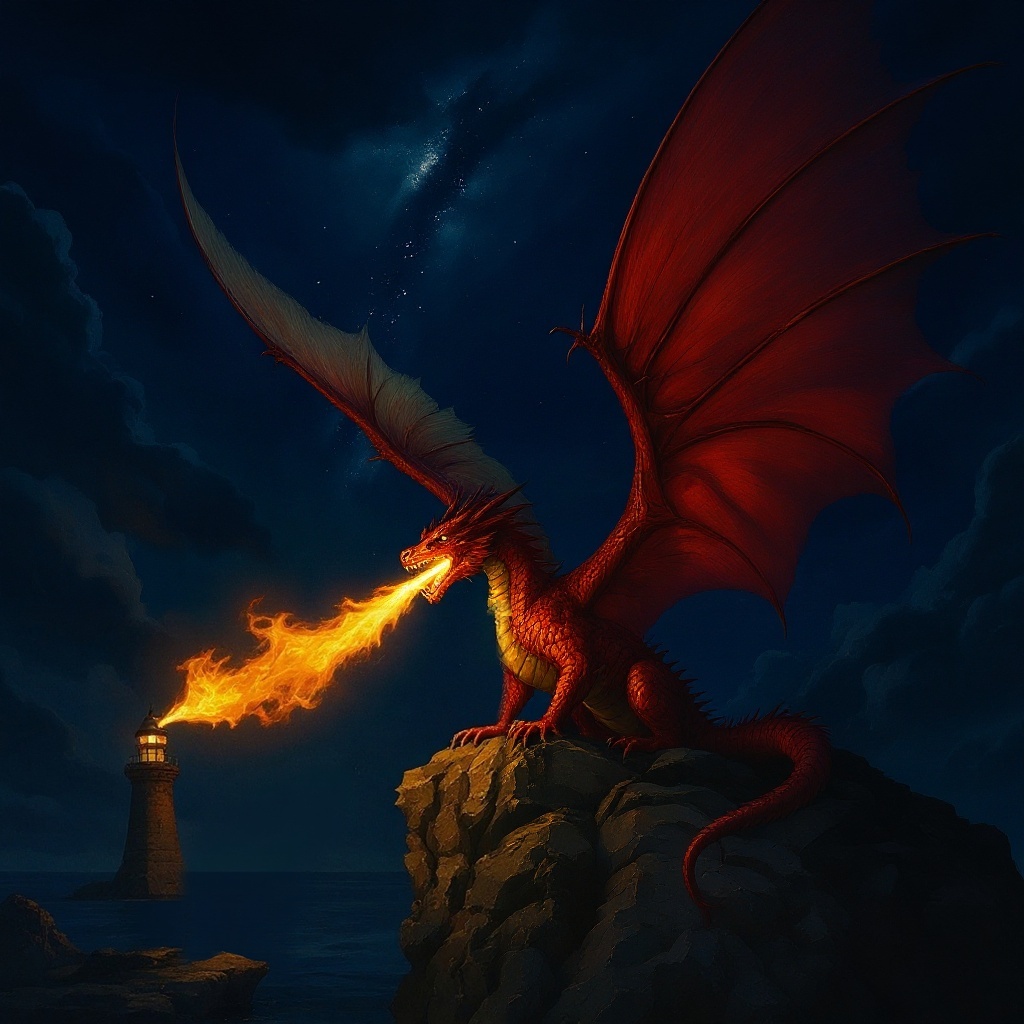
Emrys Lēʻahi is JADA’s answer to fire afloat and to the missed landfall. His body is ember-veined crimson with a golden underbelly; his wings are the breadth of storm-sails. He is the color of Welsh heraldic red and the color of a lighthouse lamp seen from a long way out across dark water.
He eats flame. Lightning that finds JADA’s mast lands in his jaws before it reaches the rigging. Galley fires that have no business walking find themselves simply gone — drawn into him before they can spread, with no drama and no announcement. He dries soaked lines with his breath, warms a shivering crew with the slow patience of a keeper who has been at his post for a very long time and is in no hurry.
He lights the way in. His beacon reaches across miles of dark water, steady and rhythmic — the navigational fire-tradition made wing and will. When JADA raced five passages across the open Pacific, it was his light she followed to the Diamond Head buoy each time. The beacon-fire counted five arrivals across an ocean. When she finally turned toward San Diego Bay to make it her home, the old fire followed her south.
For those who sail aboard JADA today, his gifts are subtler, and perhaps warmer for it. He is the reason the galley never smells of anything but what is being made. He is the light that makes everyone look their best in photographs on the aft deck at golden hour. He is the warmth that persists on a December evening long after any heater should have given up. He is, in the end, the fire that stays exactly where it belongs.
The Documented Traditions
The Dragon Bodyguards are story, and the crew of JADA will never say otherwise. But good story stands on real ground. These are the traditions and texts Emrys Lēʻahi is built on.
Y Ddraig Goch — the Red Dragon of Wales. The Dinas Emrys legend appears in its earliest written form in Historia Brittonum (c. 828 AD, attributed to Nennius), which describes the hillfort in Gwynedd, the hidden pool, the two sleeping dragons, and the prophetic boy Ambrosius. Geoffrey of Monmouth elaborated the legend into the Arthurian tradition of Merlin’s prophecy in Historia Regum Britanniae (c. 1136). The red dragon passed through the banner of Cadwaladr in the seventh century, flew as Henry Tudor’s battle standard at Bosworth Field on August 22, 1485, and was formally adopted as the central device of the Flag of Wales by Royal Proclamation on February 23, 1959.
Historia Brittonum, c. 828 AD (attr. Nennius) · Geoffrey of Monmouth, Historia Regum Britanniae, c. 1136 · Royal Proclamation, 23 February 1959Lēʻahi — the navigational beacon-fire tradition. The reading of Lēʻahi as lei ahi (wreath of fire) belongs to a tradition of navigational etymology connecting the headland’s name to the beacon fires that guided vessels into the channel. The Diamond Head Light was established by the U.S. Lighthouse Board in 1917 and remains the documented navigational mark for the Honolulu Harbor approach. The Transpacific Yacht Race, organized by the Transpacific Yacht Club since 1906 (with wartime gaps in 1942–1945 and 1950), designates its finish at the buoy off Diamond Head — the same navigational point that grounds Emrys Lēʻahi’s station.
Diamond Head Light, U.S. Lighthouse Board, 1917 · Transpacific Yacht Club race records, 1906–presentJADA herself. Built at the Stephens Brothers yard in Stockton, California, as hull #633 in 1938 for Delbert F. Axelson — a yard known from 1902 until its closing in 1987 for premier Pacific Coast wooden yacht construction. JADA raced five Transpacific passages, placed second overall twice, and won the 1956 Tahiti Race on corrected time. After roughly twenty years of offshore racing, she found her home on San Diego Bay. The ship herself sails there still.
Stephens Brothers Boat Builders, Stockton, CA, 1902–1987 · Transpacific Yacht Club official resultsNOTE — This page honors the navigational tradition of Lēʻahi. No Hawaiian deities, spiritual figures, or religious traditions are named, invoked, or claimed. The lore on this page is story; the scholarship is fact; the distinction is kept.
The Six Companions of JADA
Emrys Lēʻahi does not guard alone. The story told aboard JADA names five sworn companions — drawn from the river-traditions, sea-traditions, lunar traditions, and wind-traditions of every ocean JADA has crossed — and one whose name is held, for now, in reserve.